
Shifting Gears. Transitioning from Dealerships to Agency Models in Europe.
In recent years, the automotive industry in Europe has experienced a profound transformation in its retail landscape. Original Equipment Manufacturers (OEMs) are increasingly shifting from traditional dealership models to agency models, driven by technological advancements, regulatory changes, and evolving consumer behaviours. Here we explore the factors behind this transition, the current status of adoption, and the challenges and opportunities it presents.
Acceleration, adoption and hesitation.
Several factors have accelerated the movement towards agency models in the automotive sector. The COVID-19 pandemic highlighted the vulnerabilities of traditional dealership networks, as lockdowns and disruptions made it challenging for OEMs to operate and maintain sales channels. This crisis underlined the need for more resilient and adaptable retail models, prompting a shift in strategies. The pandemic also accelerated the digitalisation of automotive retail, with online car sales in Europe surging by 63%, [according to McKinsey]. This transition has made digital channels central to the car purchase journey.
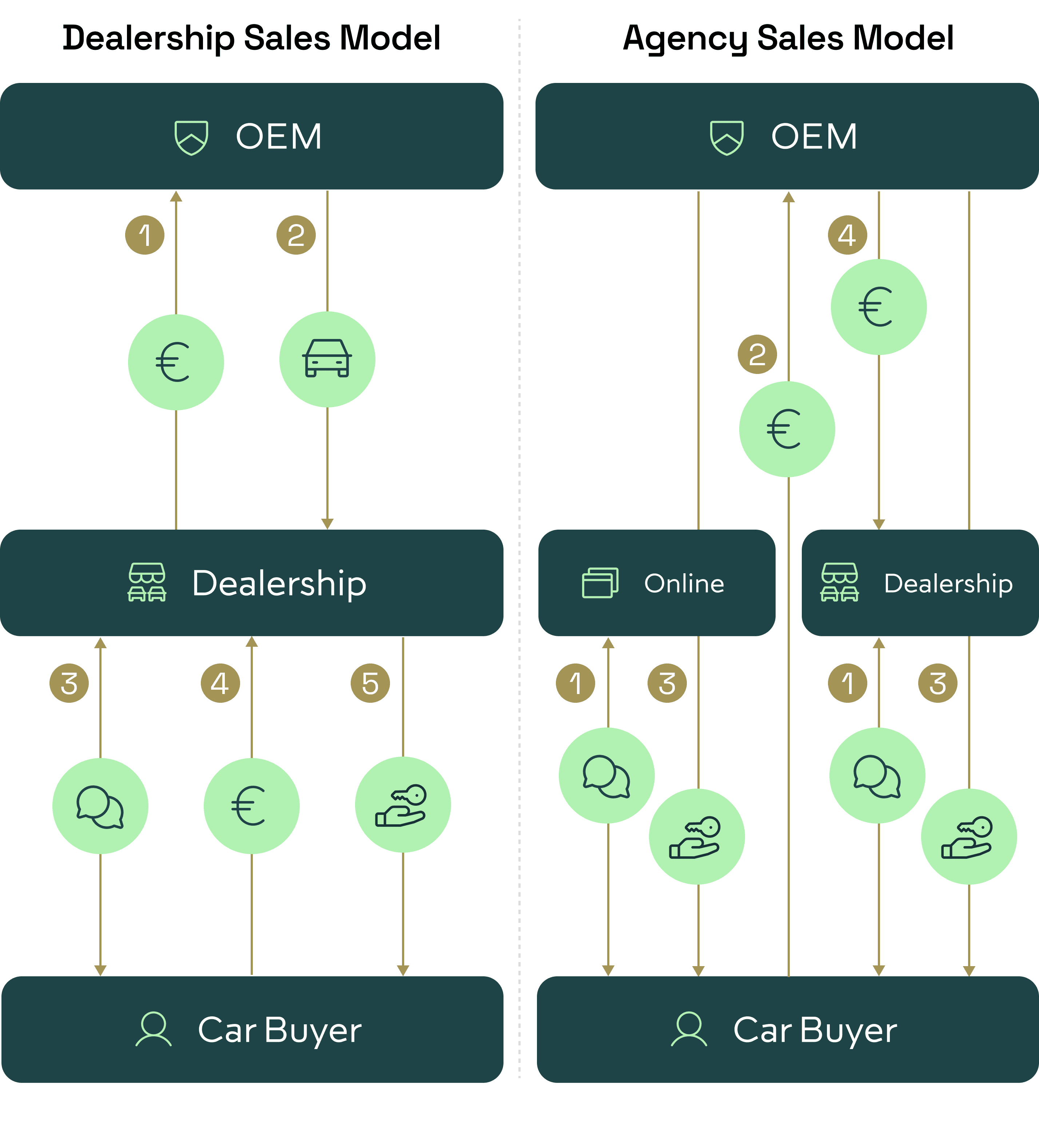
OEMs have looked for inspiration from innovators like Tesla, which pioneered direct-to-consumer sales, showcasing the potential of agency models to streamline operations and enhance customer engagement. Additionally, regulatory changes, particularly in electric vehicle (EV) sales, have reshaped the competitive landscape. The European Union’s stringent regulations, including the Motor Vehicle Block Exemption Regulation and mandates for EV sales, have compelled OEMs to reevaluate their sales and distribution strategies to fall in-step with evolving market dynamics.
To this point, recent Kaisa analysis suggests that potential EV buyers remain widely undecided, with 43% still searching for both ICE (Internal Combustion Engines) and EVs on their buying journeys.
Current Trends
While the building momentum towards agency models initially seemed unstoppable, recent developments suggest a more nuanced reality. Some OEMs, such as Volvo, Mercedes Benz, and Honda, have made significant strides toward adopting agency setups. However, others have encountered challenges, including dealer resistance and regulatory complexities. Uncertainties around EV regulations and market dynamics have introduced additional hurdles, prompting OEMs to rethink their timelines and approaches.
One significant trend is the exploration of hybrid business models by OEMs, combining elements of agency setups with traditional dealership networks. Here, flagship showrooms in urban centres specialising in EVs allow OEMs to exert greater control over the sales process while maintaining a physical presence for customers. BMW’s “Future Retail” initiative is an example of this approach, integrating digital tools and experiential or virtual showrooms to enhance customer journeys.
Challenges to change
But the transition to agency models comes with challenges. One of the primary obstacles is the resistance from entrenched dealership networks. Dealers, often entrepreneurs accustomed to autonomy in pricing and operations, can view the shift as a loss of independence and profitability. Multi-brand dealerships also face logistical complexities in navigating diverse retail models across different Auto Brands, to say nothing of the difficult management of online to offline journeys when it comes to Test Drive appointments and the delivery of cars.
Pricing control presents another significant hurdle, as OEMs strive to balance brand integrity with competitive pricing strategies. The inability to set consistent prices across regions and channels complicates online sales efforts and undermines customer trust. The rapid pace of technological innovation and frequent model updates also exacerbate inventory management challenges for dealers.
Digital Investment
OEMs will implement new CRM systems, to manage customer interactions and data throughout the customer lifecycle. By enabling them to understand customer preferences, track sales and service history, and personalise communications, CRMs significantly enhance customer satisfaction and loyalty. Delivering more tailored and effective customer experiences
Data analytics and business intelligence tools will be essential to gain insights into buyer behaviour, market trends, and sales performance. The ability to interpret data effectively allows OEMs to stay ahead of market trends, understand customer needs better, and optimise their sales and marketing efforts, ultimately driving growth and profitability.
Omnichannel communication platforms are vital for seamless communication between OEMs, dealerships, and customers across multiple channels such as phone, email, forms SMS, and chat. These platforms ensure consistent messaging, timely responses to customer inquiries, and a cohesive brand experience across all touchpoints. By utilizing Omnichannel, OEMs can control the whole car buying journey, build engaging customer experiences, improve satisfaction, and build long-term loyalty.
Preparing for the future
Despite these challenges, the transition to agency models offers compelling opportunities for OEMs to reimagine the automotive retail experience. By embracing digitalisation and personalisation, OEMs can forge closer connections with consumers, by delivering tailored experiences that drive brand loyalty and advocacy. The shift towards EVs and digitalisation underscores the need for innovative retail solutions that cater to evolving consumer expectations.
Looking ahead, collaborative efforts between OEMs, dealerships, and regulatory bodies will be crucial in shaping the future of European automotive retail. By fostering dialogue and innovation, stakeholders can navigate the transition towards agency models while ensuring a sustainable but competitive ecosystem for all.
The transition from traditional dealership setups to agency models represents a paradigm shift in automotive retail, driven by technological advancements, regulatory imperatives, and increasing consumer demands. As OEMs navigate this transition, they must embrace collaboration, innovation, and adaptability to thrive in an increasingly digital and electric future.
To conclude, we are at a tipping point, and experiments and OEM group pilot schemes have yet to prove conclusively, whether the agency model is the solution to provide the customer-centric automotive retail landscape of the future.